CECE urges for smarter rules in Europe
At the CECE Summit 2025 in Brussels, leaders demanded measurable regulatory simplification to boost Europe’s industrial competitiveness.
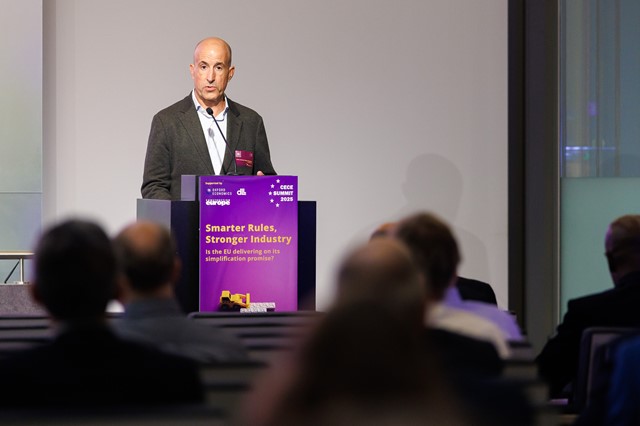 CECE President, Jose Antonio Nieto
Under the theme “Smarter Rules, Stronger Industry”, the CECE Summit 2025 gathered around 120 industry leaders, EU policymakers and technical experts in Brussels to address one of Europe’s most pressing industrial challenges: regulatory simplification. European Commission Executive Vice-President Stéphane Séjourné set the tone by calling for a “simplification shock” – a real, measurable reduction in red tape to revive competitiveness.
CECE President José Antonio Nieto emphasised in his opening speech that clarity and efficiency are essential in times of rapid technological change. “Let’s make simplification a shared mission – for a simpler, smarter and stronger future,” he urged.
Riccardo Viaggi, CECE Secretary General, framed simplification not as a slogan but as a necessity. He invited participants to challenge assumptions and help shape a leaner, more resilient industrial framework for Europe.
How do we understand simplification and what is its real impact on business, was the topic of the keynote speaker Jaroslaw Pietras, Research Associate at Wilfried Martens Centre for European Studies. He highlighted the aspect that regulating complex issues is not an easy task, and simplification could also mean a certain facilitation of legal language bringing more clarity into ambiguous language.
Barbara Bonvissuto Director at DG GROW in the Commission presented the first steps of the Omnibus Package, underlining the Commission’s ambition to cut unnecessary complexity and reduce administrative burdens across the Single Market while Jaroslaw Pietras explored the business impact of simplification. CECE experts raised concerns about the Carbon Border Adjustment Mechanism (CBAM) and questioned whether digital compliance tools truly reduce complexity.
Koert Debeuf, a professor of politics at the VUB, outlined the European Union's position in the current geopolitical environment comparing it with similar historical developments, and focusing on certain moments of “tribalisation”.
Ulrich ADAM, Director General at Orgalim, Barbara BONVISSUTO, Director at European Commission, Laura FIUMARA, Policy Manager at CECE, and Bjoern JURETZKI, Head of Unit, DG CONNECT were discussing the political stakes of simplification in the panel debate.
Dr Nicholas Fearnley, Head of Global Construction Forecasting at Oxford Economics shared a sobering forecast for the European construction sector, which saw a 19% decline in 2024. The Summit also addressed geopolitical dynamics and the role of the construction equipment industry at the crossroads of innovation and sustainability.
The Summit took place at the art deco Residence Palace in Brussels, offering a fitting backdrop for high-level dialogue. CECE thanked its sponsors – Oxford Economics, Dll and media partner Construction Europe – for supporting the event.
More news